Hunger Index
As per Global Hunger Index 2022, the list goes as follows:
| Sr.No | Country | 2014 Index | 2022 Index |
|---|---|---|---|
| 101 | Comoros | 29.1 | 26.9 |
| 102 | Rwanda | 29.5 | 27.2 |
| 103 | Nigeria | 28.4 | 27.3 |
| 104 | Ethiopia | 27.4 | 27.6 |
| 105 | Congo (Republic of) | 25.3 | 28.1 |
| 106 | Sudan | 29.3 | 28.8 |
| 107 | India | 28.2 | 29.1 |
| 108 | Zambia | 35.2 | 29.3 |
| 109 | Afghanistan | 30.6 | 29.9 |
| 110 | Timor-Leste | 33.3 | 30.6 |
| 111 | Guinea-Bissau | 30.2 | 30.8 |
| 112 | Sierra Leone | 33.1 | 31.5 |
| 113 | Lesotho | 29.3 | 32.4 |
| 114 | Liberia | 34.8 | 32.4 |
| 115 | Niger | 32.8 | 32.6 |
| 116 | Haiti | 32.6 | 32.7 |
Food stunting refers to poor nutrition, frequent infections and inadequate intellectual growth that impairs growth and development of children. This impaired growth and development in India is evident.
Since 2000, India has made substantial progress, but there are still areas of concern, particularly regarding child nutrition. The proportion of undernourished people in India's population is considered moderate.
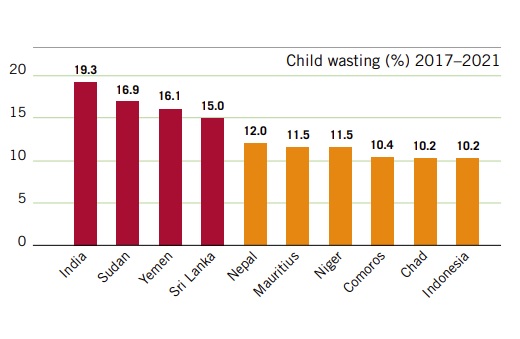
The rate of child food wastage in India is 19.3 percent. While child stunting has declined significantly - from 54.2 percent in 1998-1999 to 35.5 percent in 2019-2021 - it is still considered very high.